
Storefront next
Enterprise Power and Out-Of-The-Box Simplicity
No Compromise – the Salesforce Commerce Approach
Headless Transformation with Salesforce Storefront Next
AI is running faster than large industry cooperations are able to fully commmit to AI-usage.The run on AI is challenging big-tech companies to place their next generation software on the market. The bigger the trustworthiness in an AI-based software product is, the higher are the chances to place a sale. Conseqeuently it is less surprising that Salesforce steps into the ring to compete with Shopify, Commercetools, Big Commerce and legacy big-players. Based on a real-world client-request in form of a Headless transformation project, Positive Minds had the chance to get early access to the Best-in-Class Storefront technology by Salesforce called Storefront Next.Бъдете възможно най-гъвкави с бизнеса си, осигурете ефективно използване на ресурсите си и направете каналите си уникално свои. Винаги има рискове и неизвестни. Но намирането на решение, което наистина отговаря на вашия бизнес, винаги трябва да бъде предпочитаният вариант.
It is an Unified Commerce Experience
Salesforce empowers you to connect all your shopping channels to provide a seamless shopping experience to your end-customers. Basing on a Salesforce Commerce Cloud backend, the latest Storefront Next defines itself as an OOTB feature-rich Storefront where 3rd parties integrate via Commerce Apps.
These Apps are common ISV solutions being manageable via Business Manager where AI tooling supports developers to implement and distribute them on their own. Apart from common storefront features, Salesforce gives customers the possiblity to enrich their basic Storefront Next installation with Extensions. These are strongly frontend-focused and can be controlled on feature-switch and compiler-level.
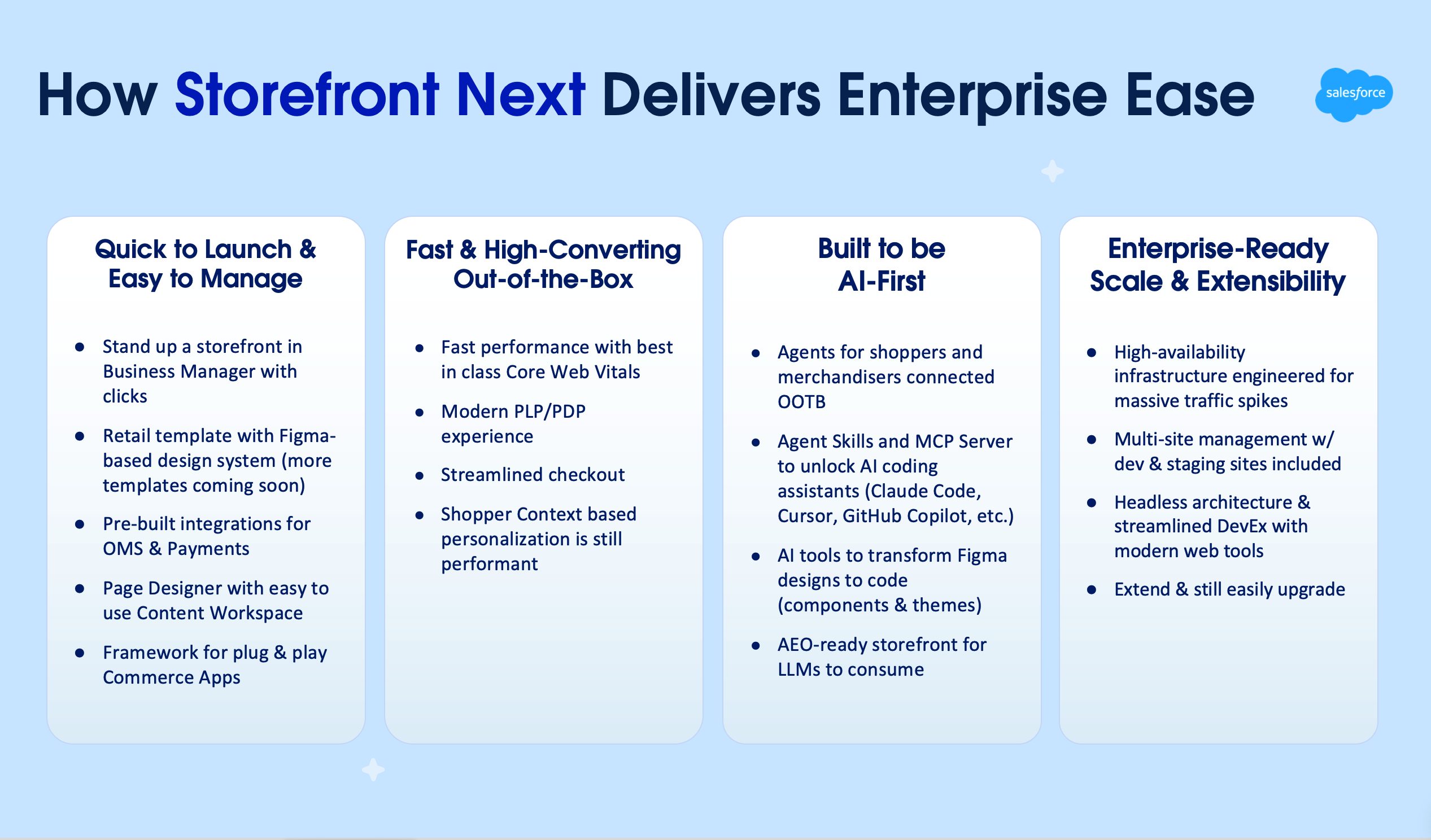
How will customers benefit from this approach?
Let’s jump back to Positive Minds’ real-world example – a Headless commerce transformation.
Whoever decides for change wants to earn a value from it. One of the values for large tech-driven companies is to modernize their aged tech-stack. No matter if it’s a migration from a legacy system like Shopify or the upgrade from an SFRA. Imagine, the client operates a self-hosted webservice that does multiple things simultaniously: it creates customers in a 3rd-party CRM system and syncs store reviews. AI will be bored to just do the transformation from code-base A to B but it will finish the task quickly. Mostly this implies saving money.
The gap: the customer does not have any value from it.
Isn’t it better to let a software architect define the transformation in a sense of splitting the purposes of the aged webservice and phrase the actual instructions?
Isn’t it better to let the senior engineer verify and review the transfomred output to proof that the actual service is headless-ready now?
With these two experts as quality assurance in between, the customer is now able to let an AI build an extra client to deliver the Unified Commerce Experience to their end-customers. Before you choose technology to take over parts of your business, it is important to understand why it needs to execute them and for what purposes. Reality proofs that customers live in highly complex ecosystems involving non-AI legacy systems or highly customizable-self-hosted stacks. Therefore each service provider is supposed to determine under what circumstances an agentic approach fits and under what not. More clearly spoken:
A service provider is indispensable to instruct AI what to manage based on seamless understanding of business processes. One of Positive Minds’ core competence is analysing and understanding customers’ business processes in their environment in its entirety to derive recommendations of action. Secondly Positive Minds passion is to deep-dive into technology to develop these actions and assure their quality. You can’t deploy what you did not review. No matter if it’s AI or a human-being: a software architect is indispensable to use AI and supervise the Intelligence’s outcome.
What Salesforce achieved
- they created an environment that empowers integrators use AI as far as they want or are allowed to
- they provide an OOTB feature-rich Storefront
- they plug-in reusable & shared integrations through Commerce Apps Framework into Salesforce Commerce Cloud as well as Extensions
Прочетете повече за нашите Услуги.
A deeper look implies
- Salesforce challenges integrators & SF-partners to design and code AI-first
- Service providers are challenged to maintain their position as trustworthy man-in-the-middle between stakeholders and technology to effectively install AI software into customer’s eco system while keeping its usage under control
- Clients benefit from an Enterprise solution which is native but not easily to customize which challenges integrators to fully support and wallets to be wide-opened
Иновативните оцеляват
No matter if there is a migration from a different e-commerce system ahead of you or the upgrade from an (very) old SFRA/SiteGenesis technology stack, this will be an approach to consider. It not only provides all the benefits this article has touched but will also accelerate your business to become AI ready. This will go beyond some new technology it will help to operate self-hosted webservices that does multiple things simultaneously like creating customers in a 3rd-party CRM system, tracking web events around this process and doing a mapping of events to satisfy legacy systems. What is your challenge?
Contact us for further advice and discussing how this approach can speed up your business transformation.
Do you have any questions? We look forward to helping you further.